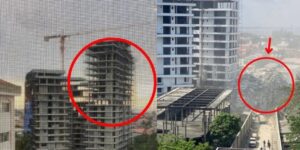
Dozens feared trapped after deadly collapse of high-rise in Nigeria

Lagos — Desperate relatives waited on Tuesday for news of missing people a day after a Lagos high-rise building collapsed suddenly, killing at least six people and leaving more trapped inside. The 21-story building was still under construction when it fell abruptly into a pile of concrete slabs on Monday in the wealthy Ikoyi district of Nigeria’s commercial capital. Rescuers said they had managed to pull six people out of the wreckage, but construction workers feared dozens of their colleagues were still trapped inside on Tuesday.

CBS News correspondent Debora Patta said that as time passed, hopes of finding any survivors were fading fast. Rescue workers and locals worked through the night, scouring the mound of rubble and twisted metal.

Sitting on the pavement near the crushed remains of the building, brothers Fawas Sanni, 21 and Afolabi Sanni, 17, were shell shocked as they waited for news of their sister. “Our sister is inside,” said Fawas, a tear rolling down his cheek. Their 25-year-old-sister Zainab was posted on September 6 to the construction site by the National Youth Service Corps, they said. “I was the last one who to spoke to her before she went to work yesterday morning,” said the older brother, covering his head with his hands.

Patta said that some local reports claimed the building had been constructed several floors higher than originally intended, and authorities were criticized by angry crowds gathered at the scene of the disaster, who said rescue efforts didn’t start quickly enough.

As Patta reported, the scene was all too familiar — a replay of building collapses that have plagued Nigeria in recent years. Collapses are tragically common in Lagos and across Africa’s most populous nation, where substandard materials, negligence and a lack of enforcement of construction standards are major problems. Lagos state police said it was too early to determine why the Ikoyi building collapsed, but Lagos emergency management agency manager Femi Oke-Osanyintolu said infractions had been committed in its construction. “We are going to get to the roots of the matter …

What Abuja Land Swap initiative means for real estate sector, investors

Once again, investors and the federal capital territory administration (FCTA) Abuja are back to the table following approval for resumption of the ambitious Land Swap Initiative by the federal executive council (FEC) early last week.

The Abuja Land Swap initiated by the Bala Mohammed administration was valued then at N1 trillion. It is the short form of the ‘FCT Land Infrastructure Swap Initiative’ designed to address the infrastructure deficit in the FCT.

In simple terms, the initiative means engaging the private sector to provide infrastructure in exchange for land. The aim, essentially, is to open up new districts in the FCT by constructing and completing access roads to those districts.

Apart from freeing government land for economic activities such as real estate and industrial development, the initiative also solves one of the major problems of urban or city development which is the provision of a good network of roads and associated infrastructure.

It is also an answer to real estate sector development in Nigeria where investors and property developers estimate the cost of infrastructure at 30 percent of total construction cost.

The implication is that the initiative will not only increase housing stock, but also reduce house price, and ultimately bridge the housing demand-supply gap in the country put variously at 17, 20 and 22 million units, depending on who one is speaking to.

It is expected that construction activities resulting from infrastructure development and housing delivery will have combined capacity to create, at least, 2,000 direct construction jobs on an ongoing basis. It is expected also that many of the workers, skilled and unskilled, will come from the catchment districts, thereby empowering the people economically.

As the federal capital city, Abuja, like Lagos, the country’s commercial nerve center, is experiencing a high influx of people and this is already putting pressure on available facilities in the city. The organization growth rate of Abuja is conservatively put at 30-40 percent per annum.

Similarly, the population of the FCT currently is estimated at 6 million whereas the Abuja Master Plan envisaged …